Showing posts with label Education. Show all posts

Tuesday, 18 May 2010

What is EOTO?


In "Precious," the class that Precious took is called Each One Teach One(EOTO). The following are some data that I found on Internet.


"Each One Teach One" is a known African-American Proverb. This phrase originated in the US during slavery, when Africans and African Americans were denied education, including learning to read. Many, if not most slaves were kept in a state of ignorance about anything beyond their immediate circumstances which were under control of owners, the law makers and the authorities. Denying education was one of the methods used to keep them docile and instill and maintain the belief that they were inferior and unworthy of a life beyond subservience, labor and harsh treatment.
Using these methods those who were in bondage to others would teach each other. This was done in violation of state and federal law, since those in the position of power used government rule to deny slaves proper education. The denial of education made it possible for the system of slavery to exist and prosper because it is HARD to enslave an educated human.

http://3rdpoblogs.com/colderice/2010/02/10/each-one-teach-one-ecommerce-topical-discussion-alpha-test/

The Different Attitude of the Teachers

In the movie, Precious, reflects the temporary education problems mainly resulting from the different attitude of teachers in American. According to Precious’ statements, her score of English was very well. However, in the pre-class test of one-by-one school, she only got two point eight while the average level was eight points; that is to say, actually, she cannot read and write. It was the teachers who were supposed to teach students from unknown to known gave Precious up by letting Precious pass the exams directly instead of taking their effort to teach the black girl. Later on, the manager of that school abandoned Precious. She sent Precious to each-one-teach-one class and pretended that the arrangement was good for her. On the other words, Precious was given up again. The school regarded the students like Precious as a trouble and got rid of a trouble with ease. They pushed away the problem rather than dealing with it. In the class of each-one-teach-one, instead of taking those students as a problem, Miss Rain taught them patiently and read their hearts from their journals. Those trouble students opened their mind to Miss Rain and had a motivation to write their dairy for sharing with their teacher. The so-called formal education got rid of troubles; while a teacher of an informal educational association took it and resolved the problems. How ironic it is! The above problems of education widely appeared. According to 1970 news on line, we could see how eager the young blacks wanting to receive education: “In the TIME-Louis Harris poll, 97% of young blacks interviewed planned to finish high school, and 67% expect to go to college.” However, white teachers had some prototype to black people as uneducated. With this attitude, regardless schools are integration or segregation ones, black students would suffered from discrimination endlessly. Therefore, if the Americans want to pursue a fair environment of education, it is better for them to get rid of racial prototype both of Blacks and Whites.

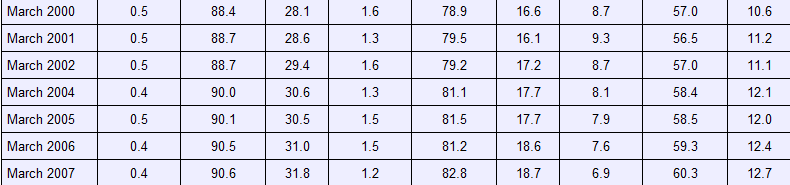
Educational Attainment by Race and Hispanic Origin, 1940–2007


In the movie that we can see in the each-one-teach-one-school, there are Hispanic, African American,and some minority in the class, except the white pepople. This situation makes up wondering the education attainment rate in the concerning of the race.

Why there is no white student in the class? The obvious answer is that the education system can not totally give a hand to those minorities in the school. As a result, they have no way but to turn to ask help from the each-one-teach-one school. The situation indicates the existing problem of the education distributing. Besides, another problem that the minority people can not fit in the society is the main reason of the lading academic performance in school.

The statistic is from the wedsite:
http://www.infoplease.com/ipa/A0774057.html

NOTE: (—) = not available.
1. Includes persons of Hispanic origin for years prior to 1980.
2. Data for years prior to 1993 include all persons with at least 4 years of high school.
3. Data for 1993 and later years are for persons with a bachelor's or higher degree.
Source: U.S. Department of Commerce, Bureau of the Census, U.S. Census of Population, 1960, Vol. 1, part 1; Current Population Reports, Series P-20 and unpublished data; and 1960 Census Monograph, “Education of the American Population,” by John K. Folger and Charles B. Nam. From U.S. Dept. of Education, National Center for Education Statistics, Digest of Education Statistics 2007, and U.S. Census Bureau, Current Population Survey, March 2007.


Information Please® Database, © 2007 Pearson Education, Inc. All rights reserved.

Statistics of African American's living, education, and degree percentages


Resource from Asia-nation: http://www.asian-nation.org/immigrant-stats.shtm

This statistic down by US census Bureau show some results that immigrants from Africa actually have the highest educational achievement rates and they also have the lowest rate of having less than a high school education. African immigrants are also most likely to be in the labor market. Therefore, it's clear that immigrants from Africa tend to come from their country's elite classes.

In contrast, the statistics point out that immigrants from Latin and South America and from the Caribbean have the lowest educational attainment rates. It makes us think of the plot about the minority and colored people in the each-one-teach-one school, such as from Jamaica. We can probably surmise from this that they are more likely to be from rural or working class backgrounds. As another example of this implication, immigrants from Latin/South America and the Caribbean have the lowest median personal (per capita) income, as well as the highest rates of living in poverty and receiving public assistance.

In addition, they have the lowest rates of being married with spouse present, working in a high skill (executive, professional, technical, or upper management) occupation and the lowest media socioeconomic index (SEI) score, a measure of occupational prestige. However, these statistics do not necessarily lead to the conclusion that immigrants from Latin/South America and the Caribbean are a drain on the U.S. economy or that they consume more benefits than they contribute. For a discussion of that issue, be sure to read the article on the impacts of immigration.

Sunday, 16 May 2010

Milestones in African American Education

Milestones in African American Education


Find information on black history and the major milestones in African-American education, including the first institute established for black students, the first black law school in the United States, the end of segregation in public schools, and more.


1837
Institute for Colored Youth founded by Richard Humphreys; later became Cheyney University.

1854
Ashmun Institute, the first school of higher learning for young black men, founded by John Miller Dickey and his wife, Sarah Emlen Cresson; later (1866) renamed Lincoln University (Pa.) after President Abraham Lincoln.

1856
Wilberforce University, the first black school of higher learning owned and operated by African Americans, founded by the African Methodist Episcopal Church. Its president, Daniel A. Payne, became the first African American Uniiversity president in the country.

1869
Howard University's law school becomes the country's first black law school.

1876
Meharry Medical College, the first black medical school in the U.S., founded by the Freedman's Aid Society of the Methodist Episcopal Church.

1881
Spelman College, the first college for black women in the U.S., founded by Sophia B. Packard and Harriet E. Giles.

1881
Booker T. Washington founds the Tuskegee Normal and Industrial Institute in Alabama. The school became one of the leading schools of higher learning for African Americans, and stressed the practical application of knowledge. In 1896, George Washington Carver began teaching there as director of the department of agricultural research, gaining an international reputation for his agricultural advances.

1944
Frederick Douglass Patterson establishes the United Negro College Fund to help support black colleges and black students.

1954
In the landmark case Brown v. Board of Education of Topeka, Kans., the Supreme Court rules unanimously that segregation in public schools in unconstitutional.

1957
President Dwight D. Eisenhower sends federal troops to ensure integration of the all-white Central High School in Little Rock, Ark. The Little Rock Nine were the first black students to attend the school.

1960
Black and white students form the Student Nonviolent Coordinating Committee (SNCC), dedicated to working against segregation and discrimination.

1962
James Meredith is the first black student to enroll at the University of Mississippi; on the day he enters the university, he is escorted by U.S. marshals.

1963
Despite Governor George Wallace physically blocking their way, Vivian Malone and James Hood register for classes at the University of Alabama.

1968
San Francisco State University becomes the first four-year college to establish a black studies department.

1969
The Ford Foundation gives $1 million to Morgan State University, Howard University, and Yale University to help prepare faculty members to teach courses in African American studies.

2003
In Grutter v. Bollinger, the Supreme Court (5-4) upholds the University of Michigan Law School's affirmative action policy, ruling that race can be one of many factors considered by colleges when selecting their students because it furthers “a compelling interest in obtaining the educational benefits that flow from a diverse student body.”

Information Please® Database, © 2007 Pearson Education, Inc. All rights reserved
http://www.infoplease.com/ipa/A0872844.html